
20 Dec Tweeting on Martin Luther King Jr. Day: The Good, the Bad and the Why?!
Holiday Participation Strategy
What is the right way for a brand to participate in MLK Day on social media?
How to decide if our brand should post on MLK Day? (Step-by-step framework)
- Clarify intent: Are we honoring Dr. King’s legacy or chasing impressions?
- Validate relevance: Do our values, programs, or history credibly connect to the day?
- Back it with action: Can we point to a concrete initiative (e.g., paid volunteer time, partnerships, community service)?
- Risk review: Would a critic find hypocrisy based on our brand’s track record?
- Message check: Remove product pushes and sales CTAs. Avoid clever wordplay around “dream.”
- Representation: Involve diverse voices internally to review tone and impact.
- Legal/compliance: Use verified quotes and images; cite sources correctly.
- Measure: Define success (e.g., sentiment, saves, volunteer signups), not just reach.
When should a brand stay silent?
- When there’s no authentic connection between your brand and the holiday.
- When you can’t back a statement with tangible action or policy.
- When your history or current practices could be seen as contradictory.
- When leadership can’t commit to follow-through after posting.
Why does action-backed content work better than statements?
Examples: The Good, the Bad, and the Why
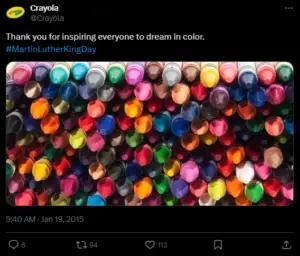
What are strong brand examples for MLK Day posts?

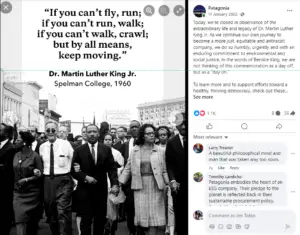

Need Help Navigating Sensitive Social Moments?
The original social media agency. Social First. Social Only.
What MLK Day brand posts backfired—and why?


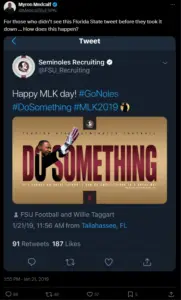
What are the most common mistakes to avoid on MLK Day?
- Product pushing or promotional CTAs
- Wordplay around “dream” or trivializing quotes
- Using unlicensed images or misattributed quotes
- Ignoring brand history or inconsistencies that invite backlash
- Posting without internal stakeholder review and community input
- Overdesigning with brand logos/colors that overshadow the message
Platform and Format Best Practices
Which platforms are best for respectful commemorations?
- LinkedIn: Ideal for company values, employee volunteerism, and partnerships. Emphasize action over aesthetics.
- Instagram: Strong for visual storytelling and carousel education; use simple, clean design and accessible alt text.
- Facebook: Community reach and local impact narratives; prioritize readability and longer captions if needed.
- X (Twitter): Keep it succinct; avoid performative threads. Link to resources or action.
- Threads: Conversational tone with clear stance, no sales hooks.
- TikTok/Shorts/Reels: If you have authentic community stories, keep them human-led; avoid meme formats for solemn observances.
Instagram vs LinkedIn: Which is better for MLK Day—and why?
| Criteria | ||
|---|---|---|
| Primary Use | Visual storytelling, carousels, short-form video | Corporate values, employee programs, partnerships |
| Best For | Quiet, visual tribute; carousel with resources | Announcing service days, donations, policy changes |
| Tone | Respectful, minimal branding | Professional, action-oriented |
| Risks | Over-design, aestheticizing a solemn topic | Corporate-speak without proof of action |
What format works best for solemn observances?
- Static post with verified quote and source
- Carousel with 3–5 educational slides and a resource link
- Short-form video from employees/community partners sharing impact
- Link post announcing store closures or volunteer initiatives
Content Creation and Approval
How to craft a respectful MLK Day post without product pushing?
- Lead with purpose: Acknowledge Dr. King’s legacy plainly.
- Cite sources: Use verified quotes with accurate attribution and year.
- Minimize branding: No products, promos, or discounts.
- Offer action: Link to volunteer opportunities, resources, or your own commitments.
- Accessibility: Add alt text, sufficient contrast, and captions for video.
What are the pros and cons of using quotes from Dr. King?
- Recognizable, meaningful, and concise
- Can elevate reflection and signal respect
- Risk of cliché or trivialization if paired with salesy visuals
- Misattribution or lack of citation damages credibility
- Overuse of “I Have a Dream” lines can feel performative
Influencer and Community Collaboration
How to engage influencers or community leaders respectfully on MLK Day?
- Partner with mission-aligned creators or local leaders already doing the work.
- Compensate fairly; do not ask for unpaid “cause” work.
- Center their voice and community—not your product.
- Share the stage: co-own content with nonprofits or community orgs.
- Publish transparency notes (e.g., paid partnership tags, donation amounts).
Measurement and Analytics
How to measure the impact of a commemorative post?
- Quality metrics: Positive sentiment, saves, shares, profile taps
- Action metrics: Volunteer sign-ups, donation clicks, employee participation
- Risk metrics: Comment moderation volume, issue escalations, time-to-resolution
- Benchmarking: Compare against prior-year holiday posts and non-holiday values content
What KPIs should we set before posting?
- Positive sentiment rate and negative comment ratio
- Save rate and share rate for educational content
- Click-through to resources or volunteer hubs
- Employee volunteer hours and partner outcomes (if applicable)
Workflows, Tools, and Budget
Which tools help approve sensitive content and manage risk?
- Social listening and sentiment: Brandwatch, Sprout Social, Meltwater
- Publishing and approvals: Sprout Social, Khoros, Hootsuite
- Asset management and rights: Bynder, Dash Hudson
- Crisis simulation and escalation: Notion/Confluence playbooks + Slack/Jira routing
- Quote verification and fact-check: Oxford Reference, Library of Congress
How to allocate budget for MLK Day and similar observances?
- Prioritize off-platform investment: employee volunteer time, matched donations
- Reserve modest paid support for partnerships or resources—not reach goals
- Fund accessibility (captions, translations, alt text QA)
- Set contingency for moderation and community management
Trends and 2025 Outlook
What are the latest trends in values-led social content?
- Proof over prose: Screenshots of internal policies and receipts of impact
- Collaboration with credible community orgs and creators
- Less branded design; more human-first storytelling
- Platform signals favor originality, utility, and saves over vanity metrics in 2024/2025
Quick Answers
What does “brandstanding” mean?
How to measure sentiment on MLK Day posts?
Which content types are safest for solemn observances?
What are the pros and cons of not posting at all?
Frequently Asked Questions
Is it okay for a brand to post on MLK Day if it has nothing planned beyond the post?
Generally, no. A post without accompanying action is the definition of “brandstanding” — and audiences have become adept at recognizing it. If your brand has no tangible commitment to back the message (volunteer programs, donations, store closures), the safest move is to stay silent and focus energy internally.
What is “brandstanding” and why does it backfire?
Brandstanding is when a company posts publicly about a social cause without substantive action behind it. It backfires because modern audiences — and AI-driven search — increasingly surface the gap between stated values and actual behavior. The disconnect erodes trust faster than silence would have.
Can small brands post on MLK Day, or is this only a risk for large companies?
The same principles apply at any size: authenticity and relevance matter more than reach. A small local business with genuine community ties and a concrete action to point to can post effectively. A large brand with a spotty track record on equity issues probably cannot — regardless of how polished the creative.
How do you avoid misattributing a quote from Dr. King?
Verify every quote against primary sources — the King Center archive (thekingcenter.org) and the Stanford King Institute are the two most reliable resources. Many quotes widely attributed to Dr. King online are misattributed or paraphrased. If you can’t confirm the source, don’t use it.
What should a brand do if its MLK Day post receives negative comments?
Pre-wire a moderation plan before publishing — assign a responder, define escalation thresholds, and draft response protocols for common objections. Respond calmly and factually; avoid deleting critical comments unless they violate community guidelines. Acknowledge any valid criticism directly rather than going silent.